And you can, too, regarding the Twilight MTR surface mine permit, S502396, 2,455 acres of former lush Appalachian forest, now a feeble attempt at reclamation by Lexington Coal Co. This permit is part of the 12-square-mile Twilight complex on Cherry Pond Mountain on the border of Boone and Raleigh Counties, WV. WV Dept. of Environmental Protection cited this permit July 29, 2021 for failure to "reclaim all secions of highwall within 180 days of final mineral removal." As of Oct. 27, 2022, WVDEP had granted 16 extensions, with the most recent "abate by" date of Nov. 29, 2022. In June, July, and August 2022, WVDEP's inspector wrote that Lexington had "ceased reclamation activities." On Oct. 27 he wrote that Lexington had "one piece of equipment that alternates between two adjacent permits..." 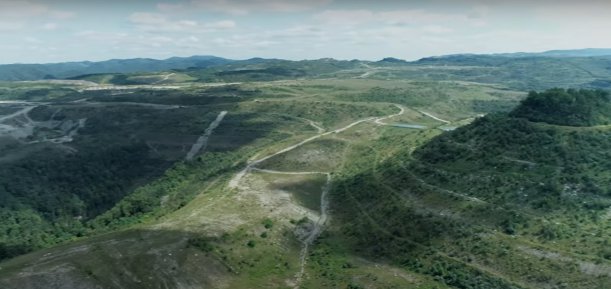 It's worth noting that Lexington has had 9 violations on this permit since July 2021, and that WVDEP suspended two adjacent permits, the Crescent 2 permit and Twilight III-A permit, on Sept. 12, 2022, and Aug. 15, 2022, respectively. The Twilight III-A permit had just been renewed four months earlier on April Fools' Day, 2022, over our objections. In March and June, we had urged stronger action, such as revoking the permits, based on Lexington's multiple patterns of violation at these permits. The suspension order on Crescent 2 has since been lifted.
--The company has repeatedly demonstrated that it has neither the intention nor the capacity to either mine or reclaim their permits in accordance with WV laws and regulations. Other permits operated by Lexington on this complex have a long list of violations and cessation orders for a variety of violations.
Lexington Coal Company has failed to meet the requirements of WV Code 22-3-19 (a) (1) because:
(A) The terms and conditions of the existing permit are not being satisfactorily met. *NOV 88 is still open, extended on multiple occasions, since first issued on Jan. 4.
(B) The present surface mining operation is not in compliance with the applicable environmental protection standards. *NOV 86, first issued over a year ago (July 29, 2021) for backfill/grading (failure to reclaim), is still unabated. Follow-up inspections on June 2, June 30, and July 28, 2022, state that "Permittee has ceased reclamation activities. Permittee is to immediately place reclamation equipment in operation and maintain reclamation activities to avoid further enforcement actions." The most recent follow-up, on Aug. 30, 2022, states, "Permittee has ceased reclamation activities for a period exceeding 60 days.
Permittee entered a verbal agreement to alternate equipment back and forth between two permits/violations of same nature but has failed to do so. Permittee is to immediately place reclamation equipment in operation and maintain constant (no bouncing between jobs) reclamation activities to avoid further enforcement actions." This dragging of their feet and thumbing their nose at WVDEP orders should cause Lexington to have this permit REVOKED rather than renewed.
(C) The renewal requested substantially jeopardizes the operator's continuing responsibility on existing permit areas. *In addition to the "bouncing between jobs" of NOV 86 described in (B) above, Lexington cannot (or will not) comply with their responsibilities on adjoining permits. WVDEP on Sept. 12, 2022, issued a Suspension Order for Lexington's adjoining permit S502007. Also on that permit, WVDEP issued NOV 41 on Aug. 16, 2022, and on the follow-up on Aug. 30 stated, "Permittee has ignored the immediate actions required towards abatement and has performed zero work so far." WVDEP issued NOV 42 on that permit on Aug. 25, 2022, for failure to comply with the Consent Order issued July 25, 2022. Both violations are still unabated. Adjacent permit S502408 is also the subject of a Show Cause order issued Aug. 15, 2022, and has five open, extended Notices of Violation. Lexington can clearly not handle the work required for the permits they have.
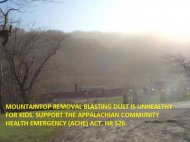
--WVDEP should not grant this permit renewal because doing so will allow Lexington Coal Company to blast on the site, causing hazardous dust to exit the permit boundary and enter the communities in the area. A significant body of peer-reviewed scientific research has documented the health effects in neighboring communities, including cancer, heart disease, and birth defects. WVDEP is unable to stop the hazardous dust from leaving the site, and cannot in good conscience grant renewal of a permit they know endangers WV residents.
--Mountaintop removal is the cradle of the climate crisis, destroying carbon-sink forests while extracting carbon that will go into the atmosphere. Yes, it's real, and serious. Even though S502396 is in "reclamation only" status, we know that it could quickly change to "moving coal," as we saw at adjacent permit S502408. And it's clear that Lexington will not reforest this site, and a few trees does not count as a forest. When the world's scientists tell us we must stop further extraction of fossil fuels, it is unconscionable to renew this permit.






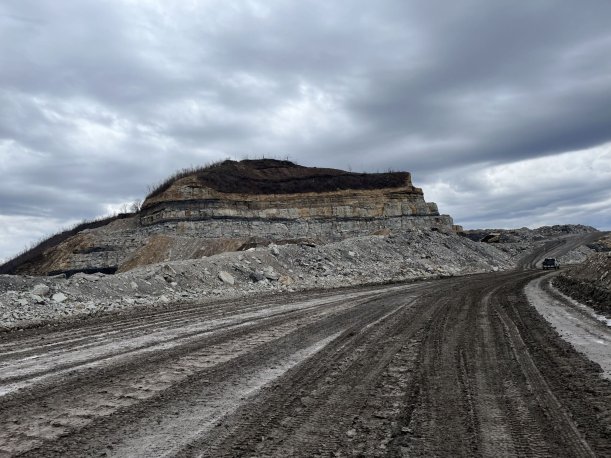 Photo by WVDEP. Details below:
 There's an online conference Dec. 14, 5:30 PM EST, available at https://meet.google.com/sba-msyz-bdy or by calling in at 1-650-667-3352, PIN 248 285 955. You can also email your comments to permit supervisor David.R.Wagner@WV.gov. Comments will be accepted up until the end of the conference. Be sure to state that you oppose renewal of Lexington Coal Company's permit number S502007. Here are some good reasons you might include:
 Artie, W.Va.—Alpha Metallurgical Resources subsidiary Republic Energy has proposed a 942-acre mountaintop removal site within a half mile of most Artie homes, between White Oak Creek and Fulton Creek. The Fulton East permit, S300721, would have 3 valley fills, including one right behind Stover Cemetery. It would impose the usual MTR hazards to the community, including blasting, with clouds of carcinogenic dust, and increased risk and severity of flooding. It would extract 4,765,000 tons of coal.
 Today, we still have over a hundred active coal sludge dams in West Virginia. Among them are the Shumate’s Branch impoundment just 400 yards upstream from the old Marsh Fork Elementary School and the Brushy Fork impoundment above the communities of Pettus and Whitesville.
 At 2.8 billion gallons, Shumate’s is more than 20 times the volume of the Buffalo Creek disaster. At around 8 billion gallons, Brushy Fork holds more than 60 times the volume. Brushy Fork holds the added distinction of being built over abandoned underground mines, the same way, and by the same company, as the Martin County, KY, sludge dam that broke through in 1994 and again in 2000. Brushy Fork is also adjacent to the Bee Tree mountaintop removal site, which is “inactive” for now but could resume operations, including heavy blasting, whenever the coal company, Alpha Metallurgical Resources, feels like it. But never fear! The coal company’s hired expert has assured them that, even if the underground mines collapsed, everything would be fine. And WV Dept. of Environmental Protection engineer Greg Demyan has stated that blasting next to a dam can be good for it; he googled it.
 Coal River Mountain Watch outreach coordinator CRMW's Junior Walk, who attended the old Marsh Fork Elementary School and lives downstream of Brushy Fork, had this to say about the 50th anniversary: